Overview
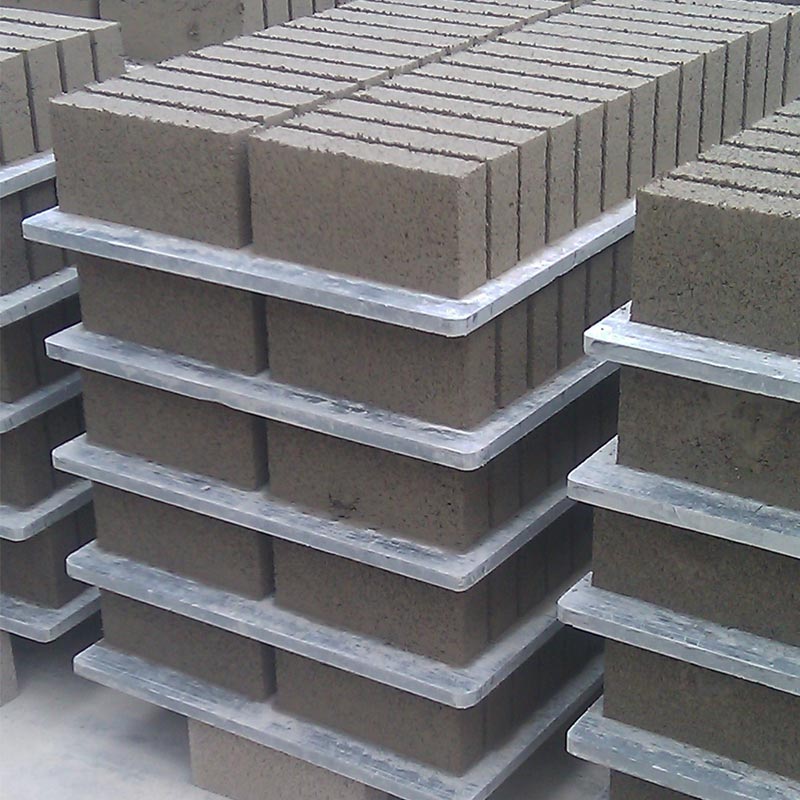
Les palettes en briques de PVC sont des panneaux porteurs de briques à haute résistance conçus spécifiquement pour les lignes de production non cuites. Elles servent de composant consommable de base dans le processus de fabrication de briques, principalement utilisées pour soutenir, transporter et empiler des produits en briques de béton tels que des briques de ciment, des blocs creux, des pavés perméables, et des pavés de fermeture, des avantages de moulage et de durcissement de pierres de bordure. En tant qu'alternative améliorée aux palettes traditionnelles en bois de plâtre, en bois et en panneaux de fibres standard, ces palettes en PVC sont fabriquées à l'aide d'un nouveau matériau PVC via un processus de moulage intégré à haute température et haute pression. Les machines clés, y compris la résistance à l'eau et à la corrosion, la fabrication dimensionnelles, la résistance à haute résistance à l'usure, la fabrication, la fabrication et à haute résistance à l'usure, sont entièrement compatibles et à la production internationale et à long service standardisées, sont entièrement compatibles avec les usines de fabrication semi-automatiques, les usines de production semi-automatiques, les usines de production internationales.
Operation
Applications
PVC brick pallets have a wide range of applications, covering the production of all types of concrete brick products. In the building materials sector, they work with brick-making machines to produce various non-fired bricks, including hollow blocks, solid cement bricks, colored permeable pavers, slope protection bricks, and interlocking pavers. In civil engineering and infrastructure, they are suitable for molding precast components, shaping small cement products, and the air-drying and transport of brick units. They are compatible with standardized indoor assembly-line production and can withstand harsh outdoor conditions, such as open-air drying, high humidity, rain, and dust. Unlike traditional wooden pallets (prone to moisture absorption and cracking) or bamboo-plywood pallets (prone to delamination and crumbling), PVC pallets perfectly meet the demands of continuous, all-weather brick production, effectively resolving industry pain points such as deformation during molding, surface defects, and rapid pallet wear. Specifications
Configuration
Manufacturing and Service Life
Manufactured using precision industrial processes with high-quality materials and mature techniques, these pallets far surpass ordinary, low-quality plastic pallets in terms of quality. Manufactured from high-density, modified virgin PVC granules and specialized additives via high-temperature melt extrusion, the boards feature a dense, uniform internal structure free from bubbles, delamination, or hollow voids. They offer an optimal balance of toughness and hardness, providing excellent resistance to impact and heavy loads without bending or deforming during long-term stacking. The edges are precision-cut and polished to a smooth, rounded finish—free from burrs or chipping—ensuring safety for handling personnel and preventing damage to equipment or the brick green bodies. The surface undergoes a wear-resistant curing process, offering slip resistance and durability that withstands repeated demolding, transport, and stacking without peeling or wearing down. Requiring no waxing, soaking, or ongoing maintenance, these boards offer zero upkeep costs and are ready for immediate use, significantly reducing labor expenses.
Compared to traditional alternatives, these PVC brick pallets offer distinct operational advantages. Traditional wooden or bamboo-laminated pallets are prone to deformation and splintering when exposed to water; debris often adheres to the bottom of the brick green bodies, compromising their appearance and quality, while high wear rates necessitate frequent replacement. In contrast, PVC pallets are structurally stable and durable—resisting splintering, deformation, and cracking—resulting in brick green bodies with consistent quality and superior flatness. Their high toughness allows them to withstand the high-frequency vibration and compression of brick-making machines, supporting continuous, high-intensity operations and significantly boosting production line efficiency. Furthermore, the product is eco-friendly, recyclable, and formaldehyde-free, meeting modern environmental standards for building material manufacturing plants.
Specification
Sizes and Load Support
Regarding specifications, these PVC brick pallets support both standardized production across multiple sizes and custom processing. They are available in a full range of mainstream dimensions—such as 850×450mm, 900×600mm, 1000×700mm, 1100×700mm, and 1200×800mm—and standard thicknesses including 20mm, 25mm, 30mm, and 35mm. They are compatible with mainstream brick-making machines like the QT4-24 and QTJ4-45.
The product features stable density and uniform load distribution, offering excellent static and dynamic load-bearing capabilities; a single pallet can reliably support the weight of stacked brick green bodies while maintaining minimal surface flatness deviation. With a moderate overall weight that balances load-bearing strength and ease of handling, the pallets are fully compatible with automated production lines—including automatic pallet feeding, discharging, and stacking systems—making them ideal for mass production in automated brick plants.
| Material | High-strength PVC composite |
|---|
| Sizes | Standard and customized dimensions available |
|---|
| Surface | Flat, seamless and wear-resistant |
|---|
| Typical Service Life | 5–6 years under standard operating conditions |
|---|
Capacity
Performance Advantages
These PVC brick pallets offer multiple core performance advantages, making them a highly cost-effective consumable for brick manufacturing.
1. Waterproof and moisture-resistant: The closed molecular structure of PVC prevents water absorption. Even with prolonged immersion or exposure to rain, the pallets do not swell, crack, or warp, completely eliminating the issues of mold, delamination, and rotting common with wooden pallets.
2. Corrosion and aging resistance: Resistant to acids, alkalis, rust, and weathering, they perform well in harsh production environments characterized by humidity, dust, and exposure to corrosive cement. They do not easily age or become brittle during long-term outdoor use.
3. Flat and wear-resistant surface: Manufactured via an integrated molding process without seams, the smooth, refined surface ensures the bottoms of the brick green bodies remain flat and clean—free from burrs or indentations—thereby significantly increasing the pass rate of finished bricks.
4. Exceptional service life: Under standard operating conditions, they offer a stable service life of 5–6 years—more than three times that of wooden pallets and double that of bamboo-plywood pallets—drastically reducing consumable costs associated with frequent pallet replacement.