



Shanman (Linyi) Maquinaria Co., Ltd.

QTS4-10 Automatic Clay Brick Making Machine

QTS4-10 Automatic Clay Brick Making Machine

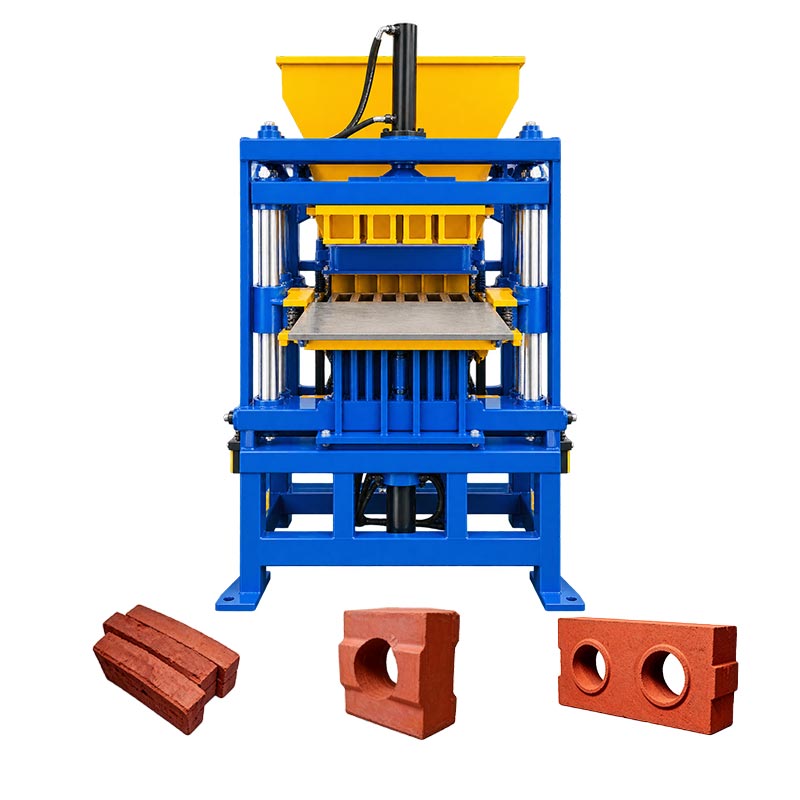
The QTS4-10 fully automatic hydraulic clay brick machine is a high-output, four-mold model designed for non-fired clay brick production. It is currently a best-selling machine in the small-to-medium-scale automated clay brick sector, offering the highest production capacity and superior stability. The machine produces four standard interlocking clay bricks per molding cycle.

Dimensions: 2,260 × 1,500 × 2,380 mm
Weight: 1,600 kg
Molding Cycle: 6–10 seconds

Overview

The QTS4-10 fully automatic hydraulic clay brick machine is a high-output, four-mold model designed for non-fired clay brick production. It is currently a best-selling machine in the small-to-medium-scale automated clay brick sector, offering the highest production capacity and superior stability. The machine produces four standard interlocking clay bricks per molding cycle.

Utilizing natural red soil, clay, or loam as primary raw materials—mixed with only a small amount of cement—this machine employs an eco-friendly, non-fired brick-making process that eliminates the need for kilns or high-temperature firing. It features a fully automatic PLC hydraulic control system that integrates material feeding, vibration compaction, high-pressure pressing, and automatic demolding. The system ensures rapid molding speeds, high brick density, and consistent product strength. It supports both standard electric motor power and optional diesel power, making it suitable for large-scale plant setups in remote areas or regions with unstable power grids. The machine utilizes a pallet-free, ground-molding process where bricks are placed directly on the ground for natural curing; this eliminates the cost of pallets and consumables, resulting in extremely low long-term production costs.

Core Product Advantages

1. **Ultra-high 4-mold capacity:** Offers the highest production capacity in its price range—doubling the output of 2-mold models—ensuring a faster return on investment and suitability for large-scale operations.

2. **31 MPa high-pressure molding:** Produces bricks with high density and strength that are resistant to cracking and deformation, ensuring high pass rates for housing construction and slope protection project inspections.

3. **Fully automated intelligent production:** Features one-touch PLC operation and automatic material feeding and demolding; requires minimal manual labor, making it ideal for stable, long-term production.

4. **Pallet-free ground production:** Eliminates the need for pallets, significantly reducing long-term operating costs.

5. **Dual power options:** The standard electric version is suitable for areas with reliable power grids, while the diesel version is ideal for remote areas with no or unstable electricity.

6. **Extremely low raw material costs:** Uses locally sourced soil with only a small amount of cement added; raw material costs are negligible, allowing for substantial profit margins.

7. **Versatile multi-purpose machine:** Quick mold changes allow for the production of construction bricks, paving bricks, and slope protection bricks, enabling the fulfillment of diverse orders and strong market adaptability.

8. **Stable, durable, and reliable:** Built with a reinforced machine body and standardized components, ensuring a low failure rate and easy maintenance for overseas operations. VIII. Brick Types Produced

By simply changing molds, the machine enables the one-stop production of a full range of clay-based, non-fired blocks:

1. Clay Interlocking “Lego” Bricks (Flagship Product): Self-locking, mortar-saving, and enabling rapid construction; a best-seller in overseas markets.

2. Solid Clay Bricks & Hollow Wall Blocks: Suitable for residential houses, boundary walls, and partition walls.

3. Interlocking Pavers & Courtyard Tiles: For surfacing rural roads and residential walkways.

4. Hexagonal & I-Shaped Interlocking Slope Protection Blocks: For eco-friendly slope stabilization along rivers, canals, and embankments.

5. Grass Pavers & Tree Pit Blocks: For landscaping and eco-friendly parking lots.

6. Retaining Wall Blocks & Hydraulic Engineering Blocks: For slope retention and soil/water conservation projects.

7. Custom-shaped engineering blocks: Mold customization based on blueprints is supported.

Application Scenarios

1. Medium-to-Large Professional Clay Brick Plants: For large-scale mass production, local wholesale, and project supply.

2. Large Infrastructure Contractors: For mass housing construction projects in rural Africa, Southeast Asia, and South America.

3. Water Conservancy & Soil Conservation Projects: Mass production of slope and bank protection blocks.

4. New Rural Housing & Affordable Housing Projects: Stable, high-volume supply of construction bricks.

5. Long-term, Stable Building Material Ventures: Ideal for investors seeking high output, high returns, and a solid long-term investment.

Model Selection & Usage Recommendations

1. Selection Advice: Choose QTS2-25 or QTS1-25 for small-scale operations or limited budgets; choose QTS4-10 for high-volume, large-scale plant operations—it offers the best cost-performance ratio among high-output clay brick machines.

2. Raw Material Requirements: Clay must be crushed and screened to prevent hard objects from entering the mold, ensuring product quality and extending mold lifespan.

3. Production Operation: Avoid frequent start-stop cycles with this fully automatic equipment; maintaining continuous operation ensures maximum output and optimal equipment stability. 4. Site Requirements: A level, hardened surface is required, along with a spacious curing area to ensure the bricks fully harden and meet quality standards.

5. Routine Maintenance: Regularly checking hydraulic fluid, tightening screws, and cleaning residual material from molds can significantly extend the equipment’s service life.

6. Production Recommendations: Suitable for continuous two-shift operation to maximize production capacity, making it ideal for securing stable, long-term orders and profitability.
Operation

The QTS4-10 features a robust, all-welded structure made from thickened, national-standard steel plate. The machine body offers high rigidity and pressure resistance, resisting deformation and enabling stable, continuous 24-hour operation. It is equipped with a high-flow hydraulic system capable of a rated high pressure of 31 MPa, ensuring uniform pressing force. With four molds forming simultaneously, the density, thickness, and uniformity of the four bricks are identical, effectively preventing defects such as size inconsistencies, voids, or loose structures.

The equipment is controlled by an intelligent PLC system that enables one-touch automated operation, handling the entire process—feeding, vibration, pressure holding, and demolding—automatically. With short molding cycles and precise movements, labor requirements are minimal, limited to monitoring the machine and transporting finished products. The molds are constructed from high-hardness alloy materials, offering excellent wear and pressure resistance as well as a long service life; they support quick disassembly and replacement, allowing for easy switching between different brick types. The equipment features adjustable pressure, height, and vibration frequency settings. Parameters can be intelligently adjusted based on local soil moisture levels, clay-to-sand ratios, and cement mix proportions to accommodate the specific raw material characteristics of different regions.

The machine boasts a mature structural design, a low failure rate, and a high degree of parts standardization, making it easy to source replacement parts overseas. An optional diesel power system allows for operation independent of the industrial power grid, ensuring stable production at remote construction sites, mining areas, and large-scale rural projects.

Working Principle

The QTS4-10 utilizes a molding process combining high-pressure hydraulic extrusion with vibration-induced compaction. First, clay, cement, and water are mixed thoroughly according to a scientifically determined ratio; the mixture is screened to remove stones and impurities, resulting in a fine, uniform raw material. This mixture is fed via an automated conveyor system into the main machine’s hopper, where it automatically and evenly fills four mold cavities. The equipment then initiates high-frequency vibration to ensure the material fully fills the cavities and to expel trapped air. Subsequently, the hydraulic system rapidly descends to apply and maintain high pressure, bonding the soil particles and cement to simultaneously press four high-density solid brick units. Once the molding and pressure-holding phase is complete, the upper mold retracts, the mold frame lowers to release the bricks, and the finished bricks are gently deposited onto the ground.

The bricks require no firing; they harden through the natural hydration of the cement. After 7–14 days of open-air curing, they achieve the standard strength required for construction, slope protection, and paving applications. The entire process is pollution-free, produces zero smoke emissions, and consumes minimal energy.

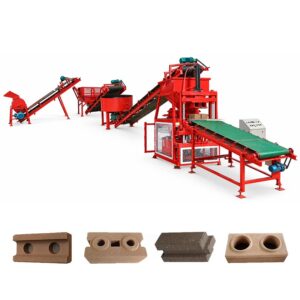
Configuration

1. Clay Crusher: Breaks down large, compacted clay clumps and refines the soil texture to ensure uniform mixing.

2. Vibrating Screen: Filters out stones, roots, and hard lumps to protect the molds and increase the yield of high-quality finished bricks.

3. Forced-Action Mixer: Thoroughly blends soil, cement, and water, ensuring a consistent mix ratio and uniform moisture content.

4. Belt Conveyor: Provides fully automated material feeding, eliminating the need for manual loading. 5. QTS4-10 Fully Automatic Molding Unit: Features synchronous pressing across four molds; serves as the core molding equipment.

6. Independent High-Pressure Hydraulic Station: Supplies stable pressing power and ensures balanced pressure across all four molds.

7. PLC Intelligent Control Cabinet: Manages automated operation, parameter adjustments, and fault alerts for the entire system.

The entire production line features a high level of automation, requiring only 2–3 operators to manage production; it is ideal for long-term, large-scale brick manufacturing.

Specification

ModelQTS4-10 Fully Automatic Clay Brick Machine
Bricks per Cycle4
Cycle Time6–10 seconds
Hydraulic Pressing Pressure31 MPa
Total Power Rating11 kW
Operating Voltage380V/50Hz (voltage customizable for different countries)
Machine Weight1,600 kg
Overall Dimensions2,260 × 1,500 × 2,380 mm
Molding MethodFully automatic hydraulic molding + high-frequency vibration
Demolding MethodFully automatic hydraulic demolding
Operators Required2–3
Molding DimensionsCustomizable for various clay brick molds

Capacity

The machine has a molding cycle of 6–10 seconds per cycle, consistently producing 4 bricks per cycle, offering significant capacity advantages:

– 8-hour single-shift output: 11,500–15,000 bricks

– 16-hour double-shift output: 23,000–30,000 bricks

Full production capacity is achievable with standard interlocking bricks; molding cycles are slightly longer for large-format slope protection bricks and thick blocks, resulting in a minor reduction in output. Overall capacity far exceeds that of standard single- or dual-mold clay brick machines, making it suitable for high-volume supply requirements.

Find the Right Brick Machine

Tell us your block type, target capacity, and budget. Our engineers will recommend the right production solution for your project.

OBTÉN COTIZACIÓN GRATIS

Demostración del formulario de contacto

By changing molds, the machine can produce hollow blocks, solid blocks, paving bricks, interlocking pavers, curbstones and other concrete products.

Common materials include cement, sand, crushed stone, fly ash, slag and other locally available aggregates. The exact mix depends on the required block strength and finish.

Yes. We can recommend or customize the machine configuration, mold design, production capacity and automation level according to your block samples and factory conditions.

Standard supply normally includes the main block machine, control system and selected mold. Mixers, conveyors, pallet systems and other auxiliary equipment can be added as required.

Yes. We provide installation guidance, commissioning, operator training, technical support and spare-parts service. Remote and on-site support options are available.

OBTÉN COTIZACIÓN GRATIS

Demostración del formulario de contacto