Aperçu
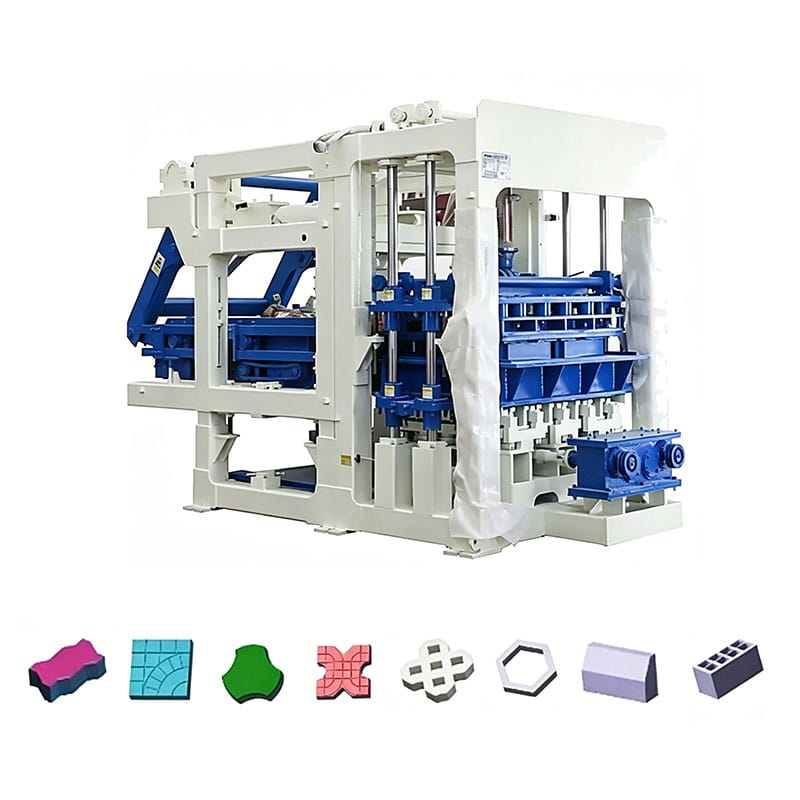
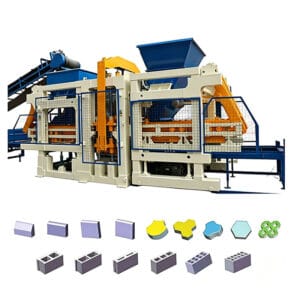
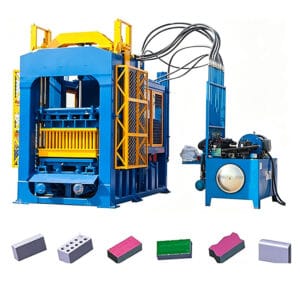
La machine de fabrication de blocs entièrement automatique QT12-15 est une unité de production à grande échelle, de haute technologie et avancée pour les briques non cuites, intégrant les principales innovations nationales aux dernières technologies internationales La machine est dotée d'un cadre construit à partir d'acier de construction à haute résistance utilisant des techniques de soudage spécialisées, assurant une durabilité exceptionnelle Elle est équipée d'un écran tactile PLC intelligent importé et de composants électriques authentiques, offrant un haut degré d'automatisation et de facilité d'exploitation Le QT12-15 est polyvalent, capable de produire une large gamme de produits en béton tels que des blocs creux, des briques poreuses, des briques standard, des pavés, des bordures, des composants d'ingénierie hydraulique à grande échelle, des pavés municipaux et des blocs de protection de pente changeant le choix de protection. Avec son moule polyvalent, le moule.
Avantages fondamentaux
1. Structure de cadre robuste et durable : construite en acier de construction à haute résistance et en techniques de soudage spécialisées pour une rigidité exceptionnelle ; présente une conception de guide extra-longue avec des colonnes de guidage chromées et résistantes à l'usure, offrant une résistance supérieure à la torsion et à l'usure.
2. Système d'alimentation en matériaux précis et stable : des mécanismes uniques de stockage et de distribution des matériaux garantissent une alimentation précise et une densité de produits constante ; un dispositif d'alimentation rapide brise-voûte facilite une distribution uniforme des matériaux, en particulier pour les briques poreuses.
3. Système de vibration avancé : utilise des vibrations entièrement synchronisées (vibrations synchrones à fréquence variable) avec des fréquences réglables pour s'adapter à des processus de production spécifiques utilisant une alimentation basse fréquence et un moulage haute fréquence pour optimiser le compactage de diverses matières premières. Comprend un système de vibration synchrone à quatre arbres et une conception spéciale autolubrifiante pour minimiser les temps d'arrêt pour la maintenance.
4. Système de contrôle intelligent : équipé d'écrans tactiles PLC intelligents importés et de composants électriques authentiques, garantissant une automatisation élevée et une facilité de fonctionnement ; comprend un système d'autodiagnostic informatique intégré et des capacités de télécommande pour la surveillance, le contrôle et le diagnostic à distance.
5. Dispositif de compensation des vibrations de l'airbag : atténue l'impact et l'usure induits par les vibrations sur la machine, améliorant ainsi la qualité des produits finis.
6. Haute efficacité et économie d'énergie : intègre la technologie allemande à fréquence variable, ce qui entraîne des économies d'énergie d'environ 30%.
7. Application polyvalente : Le changement rapide des moules permet la production de divers produits en béton, notamment des blocs creux, des briques poreuses, des briques standard, des pavés, des bordures et des briques de protection des pentes. VII. Types de briques produits
En changeant simplement de moule, la machine de fabrication de briques QT12-15 peut produire une grande variété de types de briques
• Blocs creux (par exemple, 390×190×190 mm)
• Briques multi-trous (par exemple, 240×115×90 mm)
• Briques standard/briques pleines (par exemple, 240×115×53 mm)
• Pavés/pavés colorés (par exemple, 225×112,5×60 mm, 200×100×60 mm)
• Pierres de bordure
• Blocs de protection des pentes
• Composants d'ingénierie hydraulique à grande échelle
• Pavés municipaux
• Blocs isolants légers pour granulats (céramsite)
• Blocs de béton isolants composites
Études de cas réelles
Opération
Principe de travail de base
La machine de fabrication de briques QT12-15 utilise un processus de moulage par vibration et compression Son principe de fonctionnement principal consiste à introduire un matériau en béton proportionné et mélangé avec précision dans la cavité du moule Grâce à l'action combinée de la pression vers le bas de la tête de presse et des vibrations à haute fréquence de la table, le matériau subit simultanément une pression verticale et des vibrations à haute fréquence Ce processus expulse rapidement l'air et l'excès d'humidité, assurant une liaison étroite entre les granulats et les matériaux de cimentation pour former des corps de briques à haute densité et à haute résistance Le mode de vibration principal est la vibration de table (ou la vibration synchronisée de table et de moule), avec des fréquences ajustables avec souplesse pour répondre aux exigences de production spécifiques : la basse fréquence est utilisée pour l'alimentation et la distribution des matériaux, tandis que la fréquence est différente.
Le flux de travail complet de la machine de fabrication de briques entièrement automatique QT12-15 est le suivant
1. Alimentation automatique des palettes : les palettes sont automatiquement transportées du magasin de palettes vers la position désignée au-dessus de la table vibrante.
2. Alimentation précise du matériau : le matériau tombe de la sortie de décharge dans la trémie de stockage ; un chariot d'alimentation fournit le matériau à la matrice de moulage, où un arbre d'alimentation rotatif génère une force centrifuge pour introduire de force le matériau dans la boîte de moule.
3. Fermeture et formage du moule : La tête de pression descend pour fermer le moule, tandis que le vibrateur s'active pour compacter et façonner le matériau par vibration et pression.
4. Démoulage : Après le formage, la boîte à moule se soulève pour éjecter le produit, le relâchant directement sur la palette.
5. Produit fini Sortie : Un convoyeur à palettes transfère les briques palettisées vers l'unité de déchargement des briques ; les surfaces des briques sont nettoyées avant d'être envoyées au gerbeur de palettes.
6. Durcissement et transfert : Un chariot élévateur transfère les briques finies vers la zone de durcissement pour le processus de durcissement.
Configuration
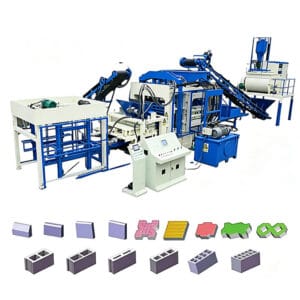
La ligne de production complète entièrement automatique associée à la machine de fabrication de briques QT12-15 comprend principalement les équipements suivants :
| Nom de l'équipement | Spécification/Modèle | Puissance |
|---|
| Station de dosage d'agrégats à trois bacs | PL1600 | 13 kW |
| Convoyeur à bande | 8m | 2,2 kW |
| Silo à ciment | 50t | — |
| Échelle d'eau | 100kg | — |
| Échelle de ciment | 300kg | — |
| Convoyeur à vis | 6,7m | 7,5 kW |
| Mélangeur à action forcée | JS1000 | 51 kW |
| Convoyeur de matières mixtes | 8m | 2,2 kW |
| Alimentateur de palettes | Pour QT12-15 | 1,5 kW |
| Machine de moulage principale QT12-15 | QT12-15 | 54,2 kW |
| Machine de transfert de briques | Pour QT12-15 | 1,5 kW |
| Ascenseur/empileuse de palettes | Pour QT12-15 | 3,7 kW |
Équipement en option : dispositif d'alimentation en matériaux, chargeur, chariot élévateur, etc.
Capacité
Le rendement théorique de la machine de fabrication de briques QT12-15 pour divers types de briques est le suivant (calculé sur la base d'un quart de travail de 8 heures) :
| Type de brique | Spécifications (mm) | Quantité par Moule | Sortie horaire | Sortie par équipe (8h) |
|---|
| Bloc creux | 390×190×190 | 12 blocs | 1 728 2 160 blocs | 17 280 blocs 3 040 |
| Brique Multi-trous | 240×115×90 | 30 blocs | 5,400 7 200 blocs | 43 200 7 600 blocs |
| Brique Standard | 240×115×53 | 60 blocs | 12 700 blocs 14 400 | 101 600 blocs 15 200 blocs |
| Pavé | 225×112.5×60 | 30 blocs | 5,400 7 200 blocs | 43 200 7 600 blocs |
Remarque : Les chiffres de production ci-dessus sont des calculs théoriques ; les cycles de moulage réels et la production dépendent de facteurs tels que les propriétés des matières premières et le type de produit.