



Шанман (Линьи) Машинери Ко, Лтд.

QTS6-10 Automatic Clay Brick Making Machine

QTS6-10 Automatic Clay Brick Making Machine

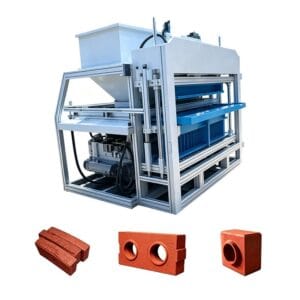
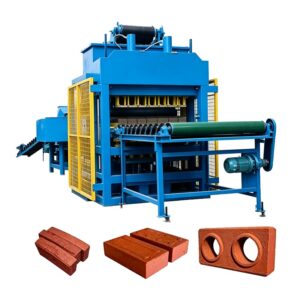
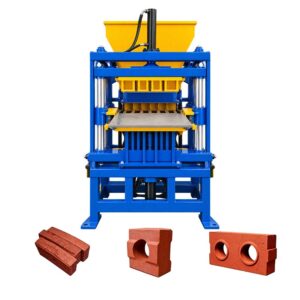
The QTS6-10 fully automatic hydraulic clay brick machine is a high-configuration, energy-efficient, six-mold, non-fired clay brick production unit. As the flagship model for mass production in the QTS series, it stably presses six standard interlocking clay bricks in a single cycle, offering superior production density compared to other machines of similar size and power.

Dimensions: 2,400 × 1,700 × 2,500 mm
Weight: 2,600 kg
Molding Cycle: 8–12 seconds

Overview

The QTS6-10 fully automatic hydraulic clay brick machine is a high-configuration, energy-efficient, six-mold, non-fired clay brick production unit. As the flagship model for mass production in the QTS series, it stably presses six standard interlocking clay bricks in a single cycle, offering superior production density compared to other machines of similar size and power.

Core Product Advantages

1. Ultra-High Capacity (6-Mold): Maximized single-mold output density; daily production increases by over 20% compared to 5-mold models, enabling faster mass production and significantly shorter payback periods.

2. Energy-Efficient Servo System: Features variable-frequency vibration and intelligent constant-pressure hydraulics; power output adjusts to demand, resulting in 30% electricity savings and lower long-term energy costs.

3. Balanced Pressure & Zero Defects: An independent flow-division and pressure-stabilization system ensures uniform thickness, density, and hardness across all six brick units, resulting in a near-zero defect rate.

4. High Adaptability to Complex Soil: Optimized for challenging soil types—including those with high clay, sand, or moisture content—offering high raw material tolerance and allowing for the use of readily available local materials.

5. High-Precision Molding Quality: Molding tolerance is ≤1mm; bricks feature clean edges and high density, ensuring a high pass rate for engineering inspections.

6. Modular Design for Easy Maintenance: Modular layout of hydraulic, electrical, and vibration systems simplifies troubleshooting; uses universal parts and ensures low maintenance costs.

7. Zero-Consumable Production: Pallet-free, ground-based production eliminates the need for ongoing consumable expenses, maximizing long-term profit margins.

8. Stable All-Weather Operation: Heavy-duty box-frame structure offers superior vibration and fatigue resistance, supporting continuous year-round production across two shifts.

9. Green & Compliant Production: A fully non-firing process with no smoke or wastewater emissions and low noise levels; meets international environmental standards and qualifies for government infrastructure project tenders. VIII. Brick Types Produced

Leveraging a rapid mold-change design, a single machine can produce a full range of clay blocks for residential, municipal, hydraulic, and landscaping applications:

1. High-spec interlocking clay “Lego” bricks: Mainstay for mass housing construction; features tight interlocking, mortar savings, and high construction efficiency.

2. High-strength solid/hollow wall bricks: Versatile blocks for high-rise perimeter walls, residential walls, and partition walls.

3. Eco-friendly permeable pavers and interlocking ground bricks: For rural roads, courtyards, and paved plazas.

4. Interlocking hydraulic slope protection bricks: For soil and water conservation projects along rivers, canals, and reservoirs.

5. Grass pavers and tree pit protection bricks: For urban landscaping and eco-friendly parking lot construction.

6. Slope retaining wall blocks and eco-friendly bank protection blocks: For hillside slope stabilization, riverbank reinforcement, and landslide prevention.

7. Customized special-shaped engineering blocks: Supports non-standard mold customization based on customer drawings.

Application Scenarios

1. Medium-to-large standardized clay brick plants: Large-scale enterprises focused on long-term mass production, local wholesale, and stable supply.

2. Large-scale overseas infrastructure projects: Mass housing and large-scale rural housing developments in Africa, Southeast Asia, and South America.

3. Hydraulic and soil conservation projects: Projects requiring large quantities of eco-friendly blocks for slope and bank protection.

4. Government rural renovation infrastructure projects: Mass production of building materials for road paving, residential renovation, and village landscape improvements.

5. Long-term production lines prioritizing low energy consumption and high output: Suitable for refined, energy-efficient, and standardized operations.

Model Selection and Usage Recommendations

1. Selection Guide: Choose a 1-2 mold model for low-volume production or startup trials; choose a 4-5 mold model for medium-volume production; for long-term, large-scale operations prioritizing energy efficiency and high output, the QTS6-10 is the top choice—it is the flagship model for mass production offering the best cost-performance ratio. 2. Raw Material Compatibility: This machine is compatible with the vast majority of natural soil types; for highly cohesive clay, it is recommended to incorporate additional screening and air-drying steps to further enhance the quality of the finished product.

3. Parameter Calibration: Upon initial startup, fine-tune the vibration frequency and pressure-holding time based on the local soil’s moisture content; once stabilized, these parameters can be saved for one-touch mass production.

4. Site Curing: The production site must be paved and leveled, with ample designated curing areas provided to prevent brick units from deforming due to stacking or losing structural integrity from rain exposure.

5. Equipment Maintenance: Regularly clean and service the servo motors and hydraulic systems to ensure unobstructed oil flow and balanced vibration, thereby extending the equipment’s service life.

6. Production Strategy: A standardized two-shift production schedule is recommended to fully leverage the high-output (six-mold) and energy-efficient capabilities of the machine, maximizing both production capacity and profitability.

Operation

The QTS6-10 features a robust, thickened box-type frame—distinct from standard welded channel-steel structures—offering superior resistance to fatigue and deformation. It is capable of continuous, 24-hour operation with an extremely low failure rate. A key upgrade is the six-mold synchronous balanced pressure system; using an independent flow-splitting and pressure-stabilizing valve assembly, it ensures uniform pressure across all six mold cavities. This resolves common issues found in multi-mold equipment, such as loose edges and corners, uneven thickness, and color inconsistencies.

The machine is equipped with a variable-frequency servo vibration system that intelligently adjusts vibration frequency and duration based on soil hardness, moisture content, and brick thickness. This ensures fuller material filling and a dense, uniform internal structure for the green bricks, resulting in finished products with higher compressive strength and greater stability. The electronic control system features a new-generation intelligent PLC panel equipped with multiple protective functions—such as parameter memory, one-touch reset, fault code self-diagnosis, overload protection, and material-shortage protection—enabling even novices to operate the machine quickly.

The mold is manufactured as a single unit from quenched alloy, offering high wear and pressure resistance, resistance to deformation, and an extended service life; it also supports rapid disassembly and switching between brick types. The machine’s electrical wiring, hydraulic circuits, and vibration systems utilize a modular layout, facilitating convenient maintenance, servicing, and parts replacement. The equipment supports dual power options—standard mains electricity or a diesel-powered modification—meeting the needs of large-scale production in environments with unstable power grids, voltage fluctuations, or remote sites lacking electricity.

Working Principle

The QTS6-10 employs a process combining servo-controlled staged vibration with multi-stage regulated hydraulic compression molding. Unlike simple standard pressing methods, this process ensures greater precision and superior product quality. The production cycle consists of five stages: material pretreatment, automatic material distribution, staged vibration, regulated pressure holding, and hydraulic demolding.

First, raw clay is crushed and screened to remove large hard lumps and impurities, then mixed with small amounts of cement and water to create a semi-dry, stiff mixture with balanced moisture content. An automated conveyor system evenly feeds the mixture into the six-cavity mold assembly. The machine initiates low-frequency pre-vibration to ensure the material fills all corners of the mold cavities, followed by high-frequency precision vibration to expel trapped air. Subsequently, the hydraulic system descends at a steady speed, applying staged pressure and maintaining regulated pressure to tightly interlock and bond the soil particles, simultaneously forming six high-density brick blanks. Once pressure holding is complete, the upper mold rises smoothly while the mold frame descends synchronously, achieving stable, damage-free automatic demolding; the resulting brick blanks are neatly formed and free from deformation.

Configuration

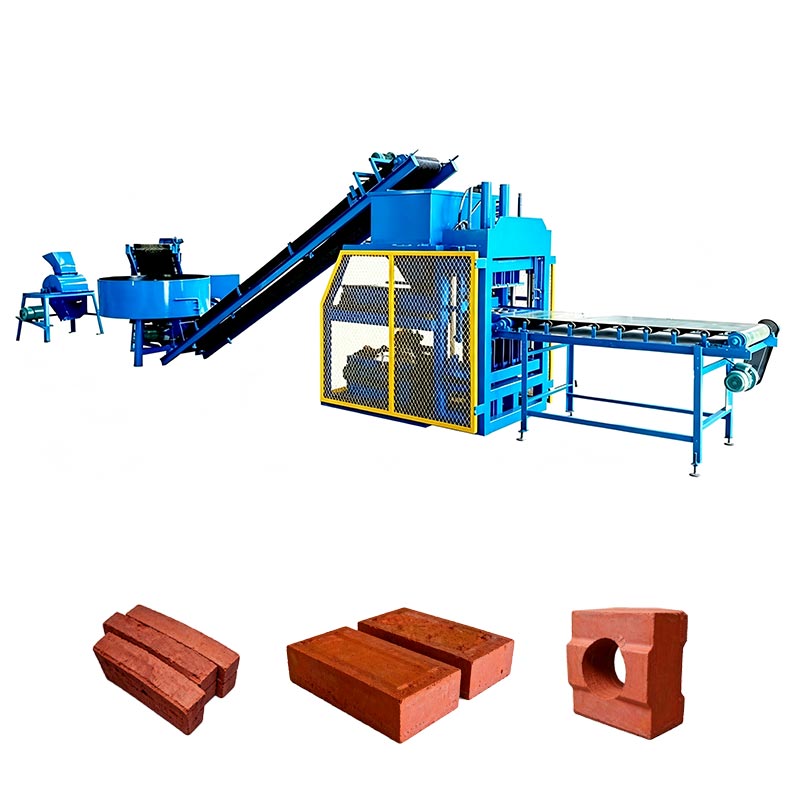
The QTS6-10 features a fully automated, closed-loop production line designed for high-volume, standardized manufacturing. The equipment operates with clearly defined functions and seamless system integration:

1. Heavy-duty clay crusher: Designed to powerfully crush compacted hard soil and clumpy red clay; suitable for pre-processing high-viscosity soil.

2. Multi-layer vibrating screen: Filters out impurities and precisely screens raw materials to ensure consistency across the six-mold forming process.

3. Forced twin-shaft mixer: High-capacity mixer ensuring uniform material blending; suitable for continuous, non-stop production.

4. Fully automatic quantitative feeder conveyor: Supplies material at a constant speed and volume, preventing issues such as material shortages or spillage across the molds.

5. QTS6-10 six-mold forming unit: The core forming component that executes synchronous vibration, pressing, and demolding for all six molds.

6. Independent constant-pressure hydraulic station: Ensures balanced oil distribution, maintaining stable and synchronous pressure across all six molds.

7. Intelligent PLC control cabinet: Manages integrated system control, parameter adjustment, self-diagnostics, and overload protection.

Specification

ModelQTS6-10 Fully Automatic 6-Mold Clay Brick Machine
Bricks per Mold6 bricks
Molding Cycle8–12 seconds
Rated Hydraulic Pressure28 MPa (stable and adjustable)
Total Power18.5 kW (energy-saving servo system)
Operating Voltage380 V / 50 Hz (customizable for international voltages)
Machine Weight2,600 kg
Overall Dimensions2,400 × 1,700 × 2,500 mm
Vibration MethodServo-driven variable-frequency vibration (adjustable)
Molding ProcessMulti-stage stable-pressure hydraulic molding
Demolding MethodFully automatic, smooth hydraulic demolding
Operators2–3 people
Production MethodPallet-free, ground-based, non-fired molding

Capacity

This machine features simultaneous six-mold forming, offering a stable cycle and high output that outperforms smaller-mold models across the board:

– Standard molding cycle: 8–12 seconds/mold

While standard interlocking pavers can be produced at full capacity, the cycle time increases slightly for large-format slope protection bricks and thick engineering blocks—resulting in a minor reduction in output—yet overall daily and annual production figures remain at the forefront of the industry for clay brick machines of this specification, offering a distinct advantage in large-scale production.

Find the Right Brick Machine

Tell us your block type, target capacity, and budget. Our engineers will recommend the right production solution for your project.

ПОЛУЧИТЬ БЕСПЛАТНУЮ ЦИТАТУ

Контактная форма Демо

By changing molds, the machine can produce hollow blocks, solid blocks, paving bricks, interlocking pavers, curbstones and other concrete products.

Common materials include cement, sand, crushed stone, fly ash, slag and other locally available aggregates. The exact mix depends on the required block strength and finish.

Yes. We can recommend or customize the machine configuration, mold design, production capacity and automation level according to your block samples and factory conditions.

Standard supply normally includes the main block machine, control system and selected mold. Mixers, conveyors, pallet systems and other auxiliary equipment can be added as required.

Yes. We provide installation guidance, commissioning, operator training, technical support and spare-parts service. Remote and on-site support options are available.

ПОЛУЧИТЬ БЕСПЛАТНУЮ ЦИТАТУ

Контактная форма Демо